



BONJOUR, GUTEN TAG, SALAAM, HELLO.
At the University of Bolton this week Robert Lo Bue and Anthony Ash from Applingua gave a great presentation on Localisation within the games industry. Delving into different aspects such as how to localise a game, cultural appropriacy and more. The common belief is that localisation is just translating a game into different languages around the world, where as this is a major part, however it is not the only aspect as adaption of the product also plays a large part of localisation.

Picture: http://blog.mobiversal.com/8-key-steps-for-streamlining-the-localisation-of-your-app-or-website.html
Firstly looking into translating, this begins by finding all the words within the product and passing them onto someone to translate into different languages. The best candidate for this would be someone with the language as their native language and also someone who cares for games. Robert Lo Bue mentioned that if it was handled by a legal translator some aspects of the design may be lost, due to the person translating being too literal and not having a sense of what translation is required in the given situation. Miguel Á. Bernal-Merino delves deeper into this in his piece on 'On the Translation of Video Games' (Bernal-Merino 2006). Mr Bernal-Merino mentions how different staple principles of the games industry does not translate easily to other languages and cultures, especially in terms of terminology.
An example of this would be how Americans state they have 'beat' a game, whilst English gamers state they have 'finished' a game and as a final example of the same state Japanese gamers would say they have 'cleared' a game (Alexander, 2014). This would affect localisation as to give the most adequate feedback in relation to the players location around the world the words would be changed, such as a fighting game stating 'level cleared' for Japanese players or 'level finished' for English players. This however is only a small example of a vast amount of changes for localisation.

Picture: http://blog.lionbridge.com/translation/
Next looking into the factor of localisation that's often overlooked by consumers which is adaption. Note: Apart from severe cases which will be discussed further in this blog. Adaption is having to change to a new stimuli or in the terms of localisation having to adapt to a new environment, such as government statutes like laws and regulations in certain countries that are not in effect in others, also including aspects such as cultural significance and more. A good example of rules and regulations affecting a game in a significant way would be monetisation rules in China. Google play in China is not allowed to have in app purchases on its applications/games (Yip, 2015). This could kill all revenue for this area of the world if the game design was heavily dependant on in app purchases, whilst able to be successful in other countries this would be hampered in China. An adaption could be raising the price of the application in China and having the 'in app purchased content' from other countries available from the start in China alone.
Another common adaption is games vying for release in Australia, of whom's ratings board are very strict even to the point that certain games will not be released in Australia. Video games often have to change gameplay scenes or even remove content to have their game pass classification in Australia, such as South Park: The Stick Of Truth (Obsidian Entertainment, 2014), which had to remove an entire scene involving aliens and probing (fitting with the games comical humour) to be released in Australia.
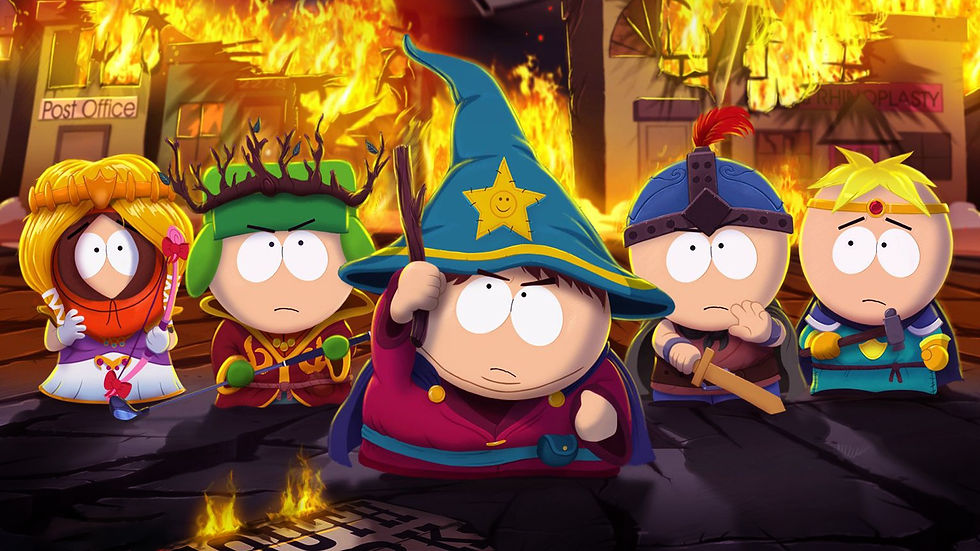
Picture: http://www.gamesradar.com/south-park-stick-truth-review/
One factor that most of the people in the games industry that have had to work with localisation can agree on is that localisation cannot be a last thought of game production. It would adversely affect the development, from examples such as China's in app purchase ban, to being outright banned in other countries such as Australia, not to mention the fact that if the translation is wrong that players who attempt to play the game can find it frustrating or even impossible to do so. All of which lead to the developer losing revenue.
References:
Alexander, L. (2014, February 10th). Beating Games Around The World. Retrieved from Gamasutra: http://www.gamasutra.com/view/news/209900/Beating_games_around_the_world.php [Accessed on 10/2/2017]
Bernal-Merino, M. (2006). “On the Translation of Video Games”. The Journal of Specialised Translation, Issue 6: 22-36.
Bernal-Merino, M. (2007). "Training translators for the video game industry", in J. Diaz Cintas (ed.) The Didactics of Audiovisual Translation. Amsterdam/Philadelphia: John Benjamins.
Huynh, G. (2014`, January 3rd). One Year On: Has R18+ changed anything? Retrieved from TechGeek: http://techgeek.com.au/2014/01/03/one-year-r18-changed-anything/
Obsidian Entertainment. (2014, March 4th). South Park: The Stick Of Truth. [Xbox 360 Video Game Software]. Rennes, France: Ubisoft.
Yip, P. (2015, January 26th). Game Localization Mistakes. Retrieved from OneSkyApp: http://www.oneskyapp.com/blog/game-localization-mistakes/ [Accessed on 10/2/2017]
Comments