


Asteria - Modular Kit
 HighresScreenshot00039 |  HighresScreenshot00035 |
|---|---|
 HighresScreenshot00030 |  Sci-Fi Kit |
 Sci-Fi Kit - Textured Example |
Project Overview
The goal of this project was to produce a piece of work to showcase abilities students have within the game design field as part of our course. Due to feeling 3D modelling was a personal weakness in my skill-set, I chose to improve my own skills with modelling and UV production showcasing off my weakest aspect in such a way that it is of game industry standard. The piece designed also shows off level design aspects and sound production, however in a minimal way as to not supersede the goal of 3D modelling being the key aspect of production.
Work Flow
It was decided upon to produce a star-ship interior. Project Codename Asteria. Several areas were chosen to be produced, such as the ship corridors, airlock, bridge, with stretch goals such as storage rooms and more. Production firstly began with models of each area such as the main corridors, then bridge and so forth. Moving on to UV production. Modelling and UV production was done in Maya 2017.
Below: Model with Lamberts (Maya2017), then the UV version and UV layout.
Level production was in stages, with testing, moving on to an Alpha version then a Beta and final version. This workflow for level production allowed changes in layout and different props to be created that may not necessarily been chosen to be produced in pre-production, to add realism or clutter etc. Level production took place within Unreal Engine 4.
Below: Early white-box, followed by testing stage and then Alpha version with a wire-frame.

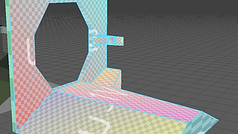

Early Changes
Work began early on with production on the corridor sections for the sci-fi environment. An initial version was completed relatively fast, allowing scale and such to be tested within UE4, however, the scale was deemed to be too large and thus the first version of the modular pieces of the corridor sections was not used and more pieces was produced. Key to this was advice from University of Bolton lecturer Phil Carlisle who’s experience within the games industry carries weight in his reasoning. Phil thought the initial testing felt too large of an area and noted a lot of sci-fi games aboard space vessels had enclosed claustrophobic environments.
Above: Early scale and UV testing phase.
Taking this advice on board changed the course of the project drastically. Without changing the initial 6 metre x 6 metre dimensions of pieces I decided to constrict player movement and give a more claustrophobic environment than initially produced by raising the floor by 1 metre and lowering the roof by 1 metre. The sides were also encroached giving the player a narrower corridor to explore whilst keeping to a realistic scale in UE4 and keeping with the modular theme.
Below: Example of floor being raised by 1 metre.


Level Design And Flow
Past experience with level design helped vastly with this aspect of the production work, as seen on my portfolio website, allowing most of the design work to be completed over the few weeks before submission. However, testing versions were produced early into development to allow testing of scale and UV on models. This moved onto an Alpha version of the level that was to be showcased, with various materials and lighting effects added to show the atmosphere. The alpha version was more in-depth with a lot of the props and variance models populating an enclosed map.
This way of production allowed me to see that certain aspects either needed to be changed, created or even removed. One example of this would be the pillar that you can see throughout the ‘Alpha’ screenshot. This pillar albeit looking great on its own, did not suit the environment it was put into. Thus, a new pillar was added to my list of props to create.
Above: Testing UV on models and material examples. This helped know what could be customised and in what ways, to create variation from the same models.
Moving on to a beta version of the level, with the newly produced ‘pillars’ and other props deemed necessary for the level. This included items such as crates to create a ‘storage room’. More work went into determining level layout with the modular pieces already created. Due to having to produce a video to show off the level, the level layout would play a key role into the visual flow. T-junctions allow suspense to be simulated, mixed with particle effects such as steam, sparks and more with final atmosphere created using lighting. A low yellow was initially used but it was decided to raise the global illumination to show off the models more within the video.
Extra attention within the final build had to be on where the matinee sequence for the video would run, without too many ‘dead’ ends and feeling like natural player movement through the environment. The goal was to showcase the level as if a player was exploring whilst showing off the different aspects and models throughout. Although level design work was not the overarching goal to showcase, it is felt that this work adequately shows off that area of my expertise.
Included are new props built based on previous levels needs such as the Alpha and Beta versions. Above left shows new pillars and their customization along with new wall panels. Above right showcases the bridge with various holographic displays added from the Infiltrator Demo via the Unreal Marketplace. All materials either came directly from the Infiltrator Demo or the Sci-Fi bunk via the Unreal Marketplace, due to lack of time and personal skill with material production. Material production will be worked on during the summer to raise this area of my skill-set.


Asteria
Project Reflection
Looking back and reflecting upon the whole project, there are many aspects I would change with my new experience of producing this work albeit I am very happy with the outcome. I firmly believe I choose to commit to too much work, but this has been a great learning experience showing me my own abilities and forcing me to work under a very pressured schedule.
The portfolio piece created albeit not completely as initially planned showcases a science fiction environment aboard a space ship, with the theme of ‘unseen’ both in terms of it being aboard a ship heading into the ‘unseen’ reaches of the universe and the questions behind the atmosphere of the level. Such as perceived broken and emptiness giving an almost horror aesthetic, again adding to the ‘unseen’ theme. The music also carries this through, what are the noises ahead and raises even more questions of ‘unseen’ aspects.
 Bridge_Whitebox_0.1 |  Lambert World_WLighting |
|---|---|
 HighresScreenshot00010 |  HighresScreenshot00011 |
HighresScreenshot00035 |  HighresScreenshot00032 |
|---|---|
 HighresScreenshot00036 |  HighresScreenshot00038 |